

Why Does TMJ Cause Jaw Tension, Facial Pain and Headaches?
TMJ symptoms rarely have just one possible cause. Teeth clenching, grinding, jaw overuse, chewing habits, injury and arthritis may all contribute. Stress can also play an important role because many people unconsciously tighten their jaw muscles when they feel under pressure.
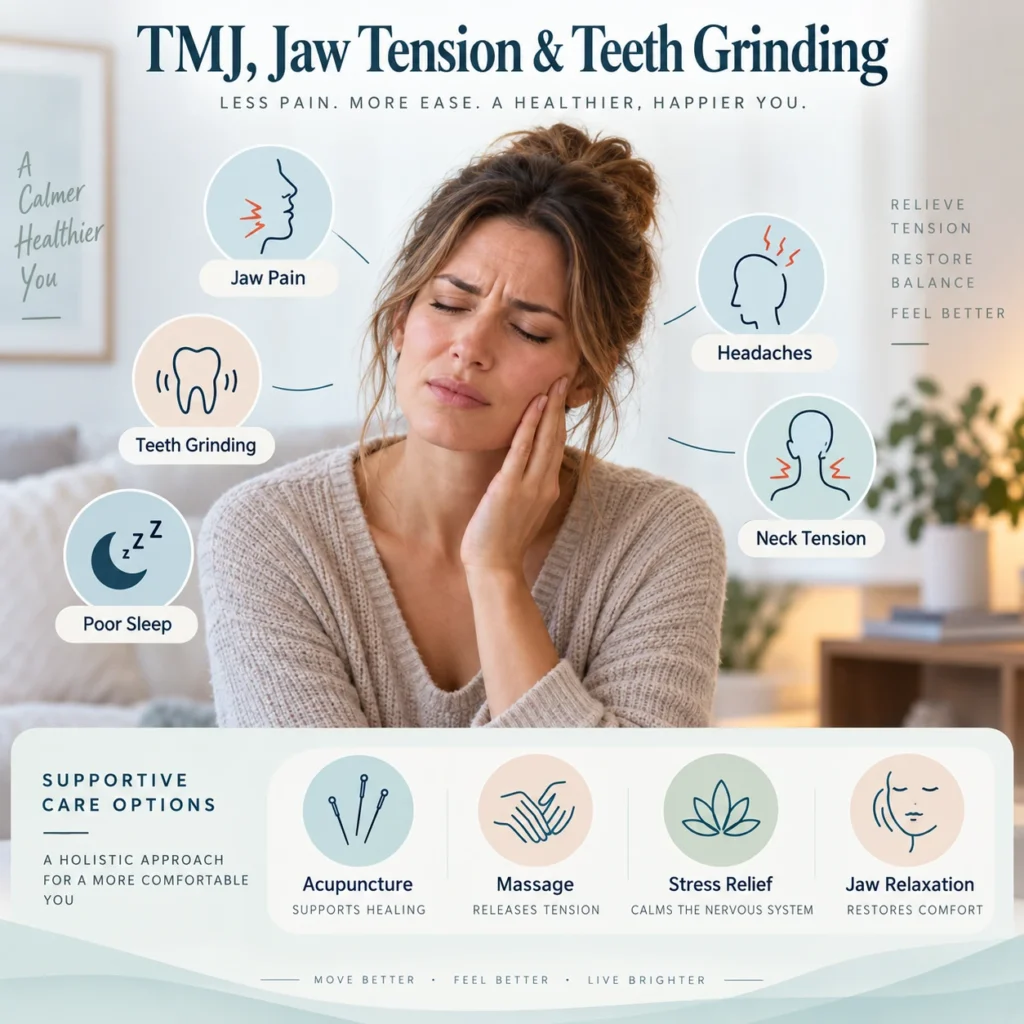
Typical symptoms can include:
- 🦷 Jaw pain or tenderness
- 😣 Tight or tired jaw muscles
- 👂 Pain around the ear
- 🤕 Headaches around the temples
- 💢 Neck and shoulder tension
- 🍽️ Pain while chewing
- 🔒 Difficulty opening the mouth normally
- 💤 Teeth grinding during sleep
- 🔊 Clicking or popping from the jaw
A clicking jaw without pain does not necessarily require treatment. However, persistent pain, locking or difficulty opening and closing the mouth should be assessed by a dentist, doctor or other qualified healthcare professional.
Jaw discomfort can also extend beyond the face. The muscles around the jaw, head, shoulders and neck work closely together. Someone with long-term jaw tension may therefore also experience the kind of muscular discomfort discussed in our guide to acupuncture and massage for neck pain.
Likewise, repeated tension around the temples, jaw and upper neck can accompany headaches. If headaches are one of your main symptoms, our article about acupuncture for migraine, headaches and muscular tension explains this relationship in more detail.
Can Acupuncture Help TMJ Pain and Tight Jaw Muscles?
Acupuncture uses very fine needles at selected points on the body. From a modern pain-management perspective, it is generally used as a complementary method for influencing pain perception, muscle tension and nervous-system responses.
Research into acupuncture for temporomandibular disorders is encouraging, although it should still be interpreted cautiously. A 2026 meta-analysis involving 19 randomized controlled trials and 708 participants found improvements in pain and maximum mouth opening compared with control interventions. Earlier systematic reviews have also reported potential benefits, although researchers have highlighted limitations in study quality and the need for stronger long-term evidence.
Therefore, acupuncture should not be presented as a guaranteed cure for TMJ disorders. Instead, it may form part of a conservative treatment strategy, particularly when muscular tension is an important component.
In our TCM practice in Frederiksberg, the treatment plan depends on where the discomfort occurs and what seems to aggravate it. For example, treatment may focus on tension around the:
| Area | Common complaint |
|---|---|
| Jaw muscles | Tightness, fatigue or soreness |
| Temples | Tension headaches |
| Around the ear | TMJ discomfort |
| Neck | Stiffness and restricted movement |
| Shoulders | Stress-related muscle tension |
| Upper back | Postural tension |
When jaw symptoms occur together with neck stiffness, we may also consider the same muscular patterns discussed in our article about massage movements for relieving neck pain. This creates a more complete treatment approach rather than treating the jaw as an isolated part of the body.
How Are Stress and Teeth Grinding Connected to Jaw Tension?
Have you ever noticed that your teeth are tightly pressed together while answering emails or concentrating on a difficult task?
Many people clench their teeth without realizing it. Bruxism can occur while awake or during sleep. Over time, repeated clenching may cause jaw tenderness, muscle fatigue and damage to the teeth. A dentist can check for signs such as worn, flattened, chipped or damaged teeth and assess whether a night guard or another dental treatment is appropriate.
Stress is particularly relevant because it may increase muscle tension and unconscious clenching. For patients whose jaw symptoms become worse during busy or emotionally demanding periods, addressing stress can therefore be just as important as working locally on the jaw.
For example, the relaxation strategies covered in our article on Chinese massage and acupuncture for stress relief can complement treatment when stress and muscular tension occur together.
Can Sleep Problems Make Teeth Grinding and TMJ Symptoms Worse?
Nighttime bruxism and sleep problems can overlap. Some people wake with a sore jaw without realizing they have been clenching or grinding their teeth during sleep. Bruxism can also occur alongside sleep disorders, including sleep apnea, which is why persistent or severe nighttime grinding sometimes requires further evaluation.
Poor sleep may also make pain and tension more difficult to manage. When a person sleeps badly, daytime fatigue can increase stress, while physical discomfort can make falling asleep even harder.
This can create a cycle:
Stress → jaw clenching → muscle tension → pain → disturbed sleep → more stress
For patients who experience both jaw tension and restless sleep, treatment may therefore look beyond the jaw itself. Our article about insomnia, frequent dreams, acupuncture and massage explains how our TCM approach considers both physical tension and sleep patterns.
Another treatment option sometimes used within TCM is moxibustion. However, moxibustion is not automatically appropriate for every TMJ patient. It is selected according to the person’s overall presentation. You can learn more about how acupuncture and heat therapy are combined in our guide to acupuncture and moxibustion for sleep problems.
Is Acupuncture or Chinese Massage Better for Jaw Tension?
The answer depends largely on what is causing the symptoms.
Chinese massage can work directly on tight muscles and surrounding soft tissue, while acupuncture provides another way of approaching pain and muscular tension. For some people, combining both methods may be more appropriate than choosing only one.
| Treatment | May be considered for | Main approach |
|---|---|---|
| 🪡 Acupuncture | Persistent jaw pain and muscle tension | Selected acupuncture points |
| 💆 Chinese massage | Tight jaw, neck and shoulder muscles | Manual muscle relaxation |
| 🦷 Dental splint | Nighttime grinding and tooth protection | Protects teeth and reduces loading |
| 🧘 Stress management | Stress-related clenching | Reduces habitual tension |
| 🏃 Exercises / physical therapy | Restricted jaw movement | Improves function and mobility |
Conservative treatments such as self-care, physical therapy and oral splints are commonly used for TMJ disorders, while acupuncture can be considered as a complementary option for ongoing pain.
The relationship between the jaw and neck is especially important. Patients who spend many hours at a computer may simultaneously develop jaw clenching, forward-head posture and shoulder tension. Our guide on office work and neck pain explains why prolonged screen work can contribute to these broader muscular patterns.
When Should You Seek Treatment for TMJ or Teeth Grinding?
Mild jaw tension may improve when you reduce clenching and allow irritated muscles to rest. However, professional assessment is important when symptoms continue or interfere with normal jaw function.
⚠️ Persistent or worsening jaw pain
⚠️ Difficulty opening or closing your mouth
⚠️ Jaw locking
⚠️ Significant tooth wear or broken teeth
⚠️ Persistent ear-area pain without a clear cause
⚠️ Severe headaches or unusual neurological symptoms
⚠️ Suspected sleep apnea
⚠️ Symptoms following an injury
For muscular and complementary care, our Kinesisk Akupunktur Center is located at Borups Allé 131 st. tv., 2000 Frederiksberg. Our approach combines traditional Chinese medicine with a broader clinical assessment of pain, stress, sleep and associated muscle tension. You can also explore our main acupuncture and TCM services to see how we approach other pain conditions such as frozen shoulder, neck and shoulder pain, tennis elbow, back pain, sciatica and migraine.
No treatment can guarantee a permanent cure because TMJ symptoms can arise from different causes. Acupuncture may help some people manage pain and muscular tension, but dental, medical or physical therapy may also be necessary
Yes. Repeated jaw clenching can strain the muscles around the jaw and temples, while TMJ disorders can occur together with headaches and neck discomfort. Persistent symptoms should be professionally assessed.
There is no universal number. It depends on how long the problem has been present, whether it is mainly muscular or joint-related, and whether factors such as stress, sleep problems or bruxism continue to trigger the symptoms