
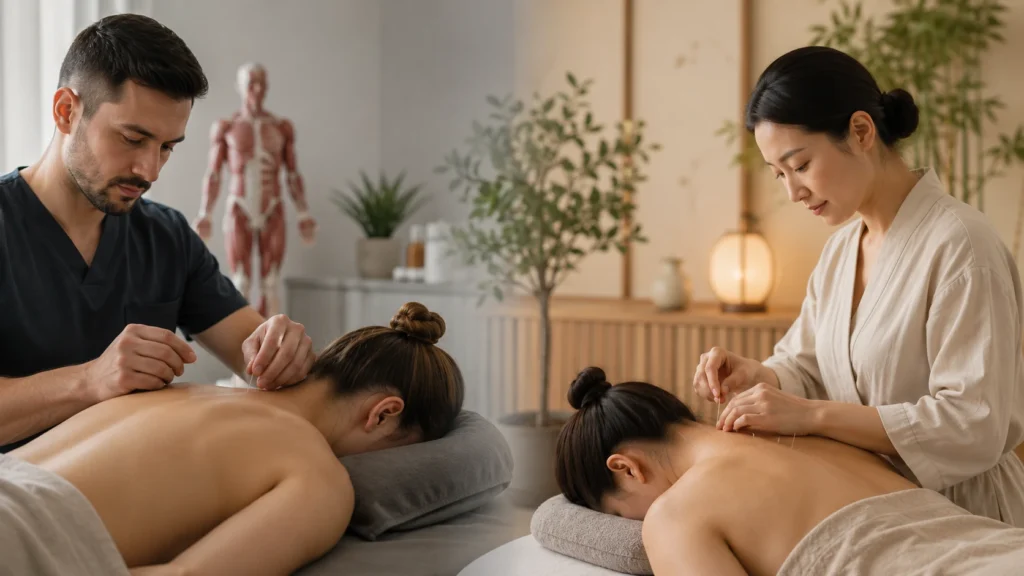
What Is Dry Needling and How Does It Work for Muscle Pain?
Dry needling is primarily a musculoskeletal treatment technique. A practitioner inserts a thin needle into or close to a myofascial trigger point—a sensitive, tight area within muscle tissue that may contribute to local or referred pain.
The goal is usually to reduce muscle tightness, improve movement and address painful trigger points. Dry needling is therefore commonly considered for problems involving muscle overuse, restricted movement and localized musculoskeletal pain.
For example, someone experiencing persistent lower-back tightness may receive dry needling directly in the affected muscles. By comparison, our approach to Chinese massage for lower-back pain and fatigue combines direct work on muscles and fascia with pressure on selected areas used in TCM.
Dry needling is often used as part of a broader physical rehabilitation programme rather than as a stand-alone treatment. Research suggests that it may help some people with musculoskeletal pain, although the quality of evidence differs considerably between conditions.
What Is Acupuncture and How Is It Different from Dry Needling?
Acupuncture has its origins in Traditional Chinese Medicine and has been practised in different forms for thousands of years. Instead of focusing only on a painful muscle or trigger point, an acupuncture treatment may include both local and more distant acupuncture points depending on the patient’s symptoms.
From a traditional TCM perspective, practitioners select points according to patterns involving Qi, meridians, Yin and Yang and the patient’s overall condition. From a modern biomedical perspective, researchers continue to investigate how acupuncture may influence the nervous system and tissues involved in pain processing.
This broader approach becomes particularly relevant when pain occurs together with other problems. Someone with chronic back discomfort, for example, may also report poor sleep, fatigue or stress. Our article on Chinese acupuncture for back pain explains how a TCM assessment considers more than the painful area itself.
Dry Needling vs Acupuncture: What Are the Main Differences?
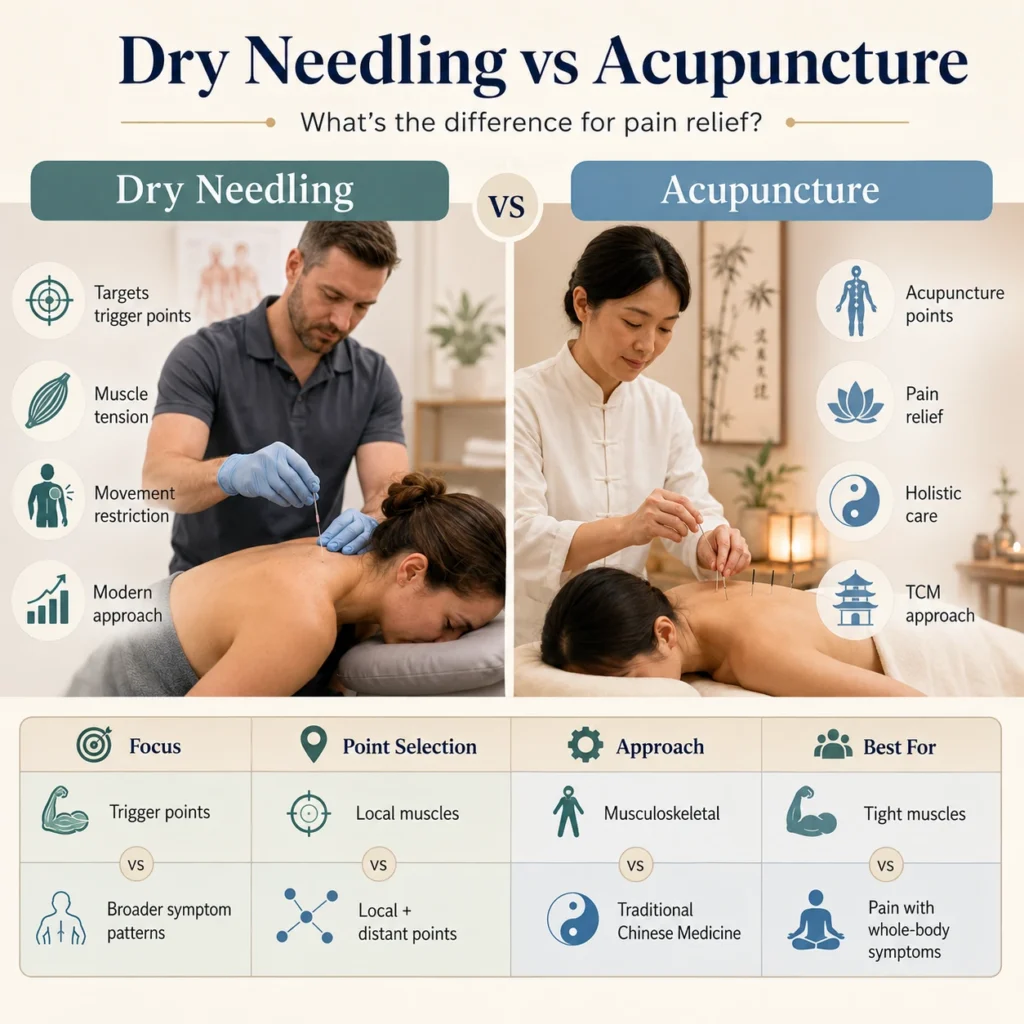
Although similar needles may be used, the two approaches should not simply be treated as different names for the same procedure.
| Comparison | Dry Needling | Acupuncture |
|---|---|---|
| 🎯 Main focus | Muscles and trigger points | Symptoms and broader treatment patterns |
| 🧠 Treatment model | Primarily modern musculoskeletal approach | Traditional Chinese Medicine plus modern clinical approaches |
| 📍 Needle placement | Often directly into or around painful trigger points | Local and distant acupuncture points may be selected |
| 💪 Common use | Muscle tightness, movement restriction, localized pain | Back pain, neck pain, headaches and other symptoms |
| ⚡ Sensation | May intentionally produce a muscle twitch | Often gentler stimulation depending on technique |
| 🌿 Other methods | Frequently combined with physiotherapy and exercises | Can be combined with TCM massage, moxibustion or lifestyle advice |
This difference becomes clearer with chronic pain. If a patient has a single, highly localized muscular trigger point, dry needling may fit the treatment goal. If pain is recurrent or occurs alongside sleep problems, stress, fatigue or several areas of tension, acupuncture may offer a broader framework for assessment.
Treatment methods do not necessarily need to compete with each other. In our clinical approach, for example, acupuncture can be complemented by manual techniques. As discussed in our guide to back-pain treatment with Chinese massage and moxibustion, different methods can address different parts of a patient’s symptom pattern.
Which Is Better for Back, Neck, Shoulder or Chronic Pain?
There is no universal winner.
Dry needling may be particularly relevant when pain is strongly associated with a specific tight muscle or trigger point. It is commonly used for localized muscle pain and movement limitations and may produce temporary soreness following treatment.
Acupuncture may be more suitable when the treatment goal extends beyond a single trigger point. People frequently seek acupuncture for recurring back or neck pain, headaches and several other chronic pain conditions. Research has found modest benefits for some types of chronic pain, although acupuncture does not work equally well for every person or every condition.
For someone experiencing back pain combined with stiffness, for instance, acupuncture might be used together with manual therapy. Our article on Chinese massage for lower-back pain explains how muscle and fascial work can complement a broader treatment plan.
Similarly, pain sometimes interferes with sleep. Instead of treating these as completely separate issues, our TCM-praksis may consider the relationship between tension, pain and rest. This is similar to the individualized approach described in our comparison of acupuncture and massage for sleep problems.
Are Dry Needling and Acupuncture Safe?
Both techniques involve penetrating the skin, so professional training, hygiene and appropriate patient assessment are important.
Temporary soreness, minor bleeding or bruising can occur after needling. With dry needling, soreness around the treated muscle is relatively common. More serious complications are uncommon but can occur when needles are inserted incorrectly, especially around the chest and other anatomically sensitive areas.
Before receiving treatment, always tell the practitioner if you:
- are pregnant;
- take blood-thinning medication;
- have a bleeding disorder;
- recently had surgery;
- have an infection or skin condition in the treatment area;
- have a compromised immune system;
- have another significant medical condition.
You should also seek medical assessment when pain follows a major injury or is accompanied by weakness, severe swelling, fever, unexplained weight loss, chest pain, loss of bladder or bowel control, or progressive neurological symptoms.
For selected patients, acupuncture may also be combined with other traditional methods. For example, moxibustion treatment uses controlled heat rather than simply adding more needles, illustrating why TCM treatment plans can involve several different therapeutic approaches.
How Do You Choose Between Dry Needling and Acupuncture in Frederiksberg?
Start with the problem rather than the technique.
At our Klinik and TCM-praksis in Frederiksberg, the first step is therefore to understand where the pain occurs, how long it has been present, what aggravates it and whether other symptoms accompany it. This helps determine whether acupuncture, Chinese massage, moxibustion or another approach is appropriate.
Choosing a practitioner also matters. Rather than simply searching for the cheapest price, the latest treatment or the best acupuncture store to buy a treatment from, look at professional experience, hygiene standards, communication and whether the practitioner understands when medical referral is necessary. Our guide to choosing an acupuncture clinic in Denmark covers several of these considerations in more detail.
📍 Akupunktur-Center Frederiksberg
Borups Allé 131, st. tv.
2000 Frederiksberg
Dry needling can sometimes create a stronger sensation because the practitioner may target a sensitive trigger point and seek a local muscle response. Acupuncture sensations vary depending on needle placement and stimulation, but many people experience only mild pressure, tingling or heaviness.
Acupuncture can include local points around painful or tense muscles, although its assessment and point-selection system is not identical to dry needling. The most suitable method depends on whether the problem is primarily localized muscle tension or part of a broader pain pattern.
There is no fixed number that applies to everyone. The treatment plan depends on the cause, duration and severity of the pain, as well as how the person responds. Chronic problems generally require reassessment over time rather than a guaranteed number of sessions.