

treating associated neck and shoulder tension caused by prolonged sitting can sometimes be an important part of a broader treatment plan.
What Causes Frozen Shoulder and Why Does the Shoulder Become So Stiff?
Frozen shoulder does not always have an obvious cause. It is most common in middle age and may appear after an injury, shoulder surgery or a period when the arm has not been moved normally. Certain conditions, including diabetes and thyroid disorders, are also associated with a higher risk.
The two characteristic symptoms are:
- 🔴 Persistent shoulder pain
- 🔒 Progressive loss of shoulder movement
Night pain can be particularly troublesome. Some people wake whenever they roll onto the affected shoulder, while others struggle to find a comfortable sleeping position.
As the condition progresses, movements such as external rotation, reaching behind the back and lifting the arm can become increasingly restricted.
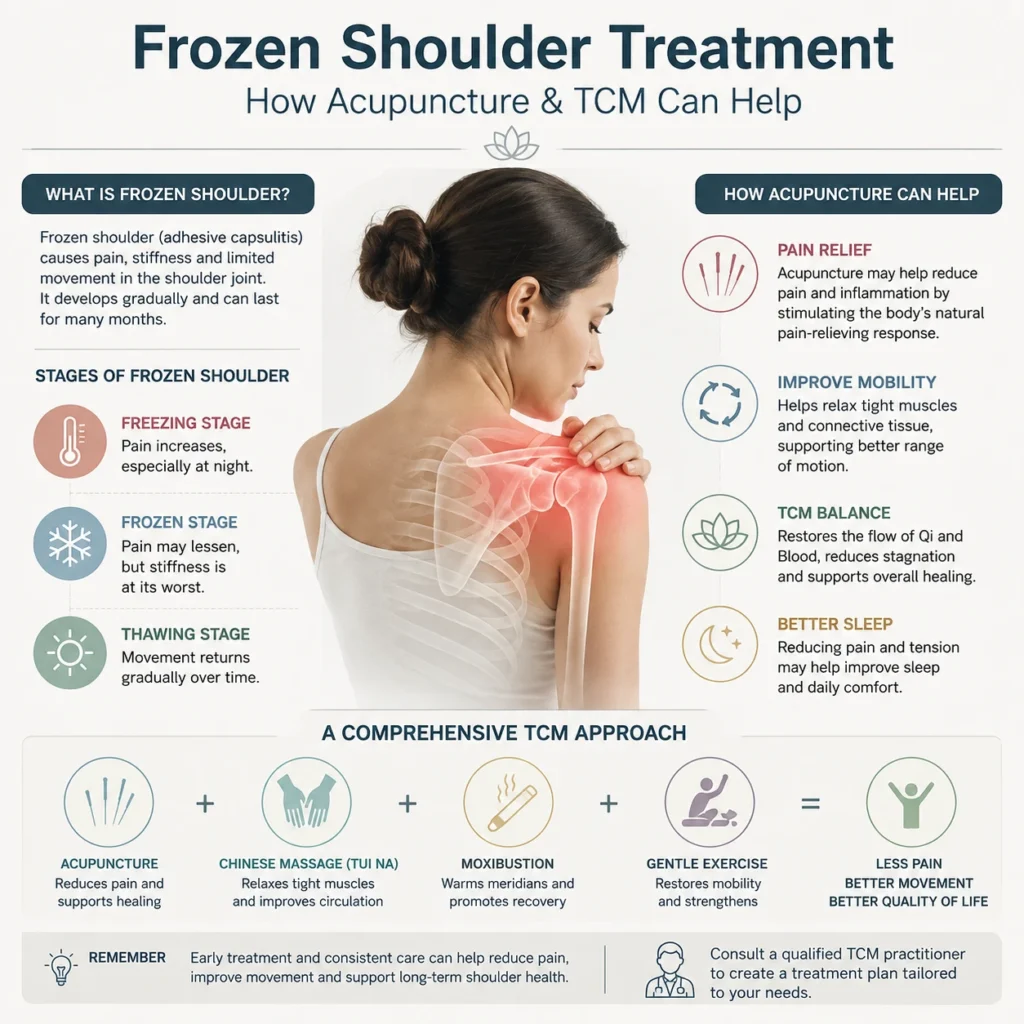
Frozen shoulder is commonly described in three overlapping stages:
| Stage | Typical Symptoms | Main Challenge |
|---|---|---|
| 🧊 Freezing stage | Increasing pain and early stiffness | Pain, especially at night |
| ❄️ Frozen stage | Less pain in some people but marked stiffness | Limited range of motion |
| 🌤️ Thawing stage | Gradual return of movement | Rebuilding mobility and function |
Can Acupuncture Reduce Frozen Shoulder Pain?
Acupuncture uses very fine needles at selected points on or away from the painful area. From a modern pain-management perspective, acupuncture may influence sensory processing and the nervous system’s response to pain. In a Traditional Chinese Medicine framework, treatment is described through concepts such as Qi, Blood and meridian circulation.
For frozen shoulder, the aim is generally not simply to place needles where it hurts. A practitioner may assess the shoulder together with the neck, upper back, arm and overall pattern of muscular tension.
This approach is relevant because people frequently compensate for poor shoulder movement by lifting the shoulder blade or tightening the neck muscles. Our article on Chinese acupuncture and massage for neck pain explains how acupuncture and manual techniques can be used together when muscle tension extends beyond one isolated area.
Which Areas May Be Addressed During Treatment?
Depending on the individual assessment, treatment may focus on:
🪡 Shoulder pain
🪡 Muscle guarding around the joint
🪡 Upper-back and neck tension
🪡 Arm discomfort
🪡 Restricted movement
🪡 Relaxation and pain-related stress
Can Acupuncture Improve Range of Motion in a Frozen Shoulder?
Pain relief is only one part of frozen shoulder treatment. The second major goal is recovering range of motion.
When movement hurts, people naturally protect the shoulder. However, completely avoiding movement can contribute to further stiffness. For this reason, healthcare guidance generally recommends maintaining gentle shoulder movement within tolerable limits and following appropriate exercises or physiotherapy advice.
Acupuncture may be useful as one component of this process. If pain and muscular guarding decrease, some people may find it easier to perform controlled mobility exercises.
A 2024 systematic review examining acupuncture combined with physical therapy reported improvements in pain as well as active and passive range of motion compared with physical therapy alone. Nevertheless, the studies showed considerable variation, so these findings should not be interpreted as proof that acupuncture will restore movement in every patient.
A practical treatment strategy may therefore look like this:
Pain management → Gentle movement → Progressive mobility → Functional rehabilitation
Rather than forcing a painful shoulder through aggressive stretching, treatment should reflect the stage of frozen shoulder and the person’s tolerance.
The same principle applies to other musculoskeletal problems. For example, our approach to acupuncture and Chinese massage for lower-back pain combines symptom management with movement and practical daily recommendations rather than relying on one technique alone.
Is Chinese Massage Helpful for Frozen Shoulder?
Chinese massage, often called Tui Na, can be considered when muscle tension around the shoulder, upper arm, neck and upper back contributes to discomfort.
For example, Tui Na may be used to:
✅ Relax overworked neck and shoulder muscles
✅ Reduce protective muscular tension
✅ Encourage comfortable movement
✅ Work on associated upper-back stiffness
✅ Prepare the area for gentle mobility exercises
This distinction is important.
Someone with ordinary muscular shoulder tension may tolerate stronger massage, whereas an individual in the painful freezing stage of adhesive capsulitis may require a much gentler approach.
Our guide to massage movements for neck pain describes several manual approaches, including Tui Na and acupressure, that can also help explain why surrounding muscle groups are considered when shoulder function becomes restricted.
Which Is Better: Acupuncture or Chinese Massage?
Neither is automatically “best.”
| Treatment | Main Focus | May Be Useful For |
|---|---|---|
| 🪡 Acupuncture | Pain modulation and TCM point treatment | Pain, guarding and general discomfort |
| 💆 Tui Na massage | Muscles and soft tissues | Neck, shoulder and upper-back tension |
| 🧘 Exercise / physiotherapy | Joint movement and function | Restoring range of motion |
| 🔥 Heat-based treatment | Warmth and relaxation | Selected patterns and muscle tension |
| ⭐ Combined approach | Multiple contributing factors | Individualised rehabilitation |
Can Moxibustion or Heat Therapy Be Combined with Acupuncture?
Moxibustion is a traditional TCM technique that uses heat generated from moxa, usually prepared from mugwort (Artemisia vulgaris), near selected acupuncture points.
Within Traditional Chinese Medicine, practitioners may consider moxibustion when symptoms fit a pattern traditionally associated with Cold, stagnation or insufficient warmth.
It should not, however, be presented as a universal frozen shoulder treatment.
A practitioner first needs to assess whether heat is appropriate. During an acute inflammatory episode or in people with reduced skin sensation, certain skin conditions or impaired heat perception, additional caution is necessary.
For patients interested in understanding how the two methods differ, our discussion of Chinese massage and moxibustion for musculoskeletal pain provides a useful example of how warming therapy and manual techniques can be incorporated into a wider TCM treatment plan.
When Should You Seek Treatment for Frozen Shoulder?
Consider seeing a doctor or qualified healthcare professional when:
⚠️ Shoulder pain and stiffness continue without improvement
⚠️ You are unable to raise or rotate your arm normally
⚠️ Night pain repeatedly disturbs your sleep
⚠️ Everyday activities such as dressing become difficult
⚠️ Symptoms are becoming progressively worse
⚠️ You are unsure whether it is frozen shoulder or another condition
Seek more urgent assessment if the pain appeared after significant trauma, the shoulder is visibly deformed or very swollen, or you develop persistent numbness, loss of sensation, fever or marked weakness.
If you are comparing clinics, our guide on how to choose an acupuncture clinic in Denmark explains why practitioner qualifications, assessment, treatment planning, price and possible reimbursement are more important than simply searching for the latest, best, cheapest price, or trying to buy treatment as though it were a product from an online store.
📍 Akupunktur-Center Frederiksberg
Borups Allé 131, st. tv.
2000 Frederiksberg
Recovery varies considerably. Frozen shoulder often lasts many months and, in some people, can continue for several years. Improvement usually occurs gradually rather than suddenly.
Gentle movement is generally encouraged, but aggressive exercises that sharply increase pain are not recommended. The appropriate intensity depends on the stage of the condition, so physiotherapy or professional guidance can be useful.
There is no fixed number. Treatment frequency depends on pain severity, how long the condition has been present, range-of-motion restriction and whether acupuncture is being combined with exercise or physiotherapy. Progress should be reviewed rather than promising a predetermined number of sessions.